
The 7 Biggest Challenges CMOs Face in 2026
A practical guide to making sharper decisions across budgets, AI, measurement, data, discovery, trust and talent.
Explore the biggest challenges for CMOs in 2026, from flat budgets and AI readiness to measurement, data, discovery, trust and talent.
In 2026, contradictions define the CMO operating environment: build the brand and prove revenue impact; move quickly with AI and govern it responsibly; personalize every interaction and protect customer trust.
The budget has not expanded to match the mandate. Gartner’s 2026 CMO Spend Survey found that marketing budgets average 7.8% of company revenue, only slightly above 7.7% in 2025. More than half of CMOs say they lack the budget or resources to execute their strategy.
That makes the biggest challenges for CMOs in 2026 less about chasing every new channel and more about choosing what the organization will fund, stop and measure. Seven issues deserve the sharpest attention.
The 2026 CMO Pressure Equation
1. Delivering growth with a budget built for maintenance
The first challenge is economic. Boards expect growth and efficiency while customers remain selective and media costs stay exposed to volatility. Gartner reports that 56% of CMOs believe they lack the budget required for their 2026 strategy, while 54% report insufficient resources.
A flat budget cannot support an expanding list of priorities indefinitely. The practical move is to manage marketing as a portfolio with distinct jobs: near-term demand capture, medium-term market development and longer-term brand or capability building. Each investment needs an owner, an intended business effect and a decision date.
Retire duplicated tools, campaigns without a defined audience and legacy programs protected only by habit. Budget agility is more valuable than a perfect annual plan when the market can change between quarters.
2. Turning AI from a collection of pilots into an operating capability
AI investment has moved from experimentation to expectation. Gartner says CMOs now allocate an average of 15.3% of marketing budgets to AI, yet only 30% report mature or fully developed readiness. The gap is not access to tools. It is the data, governance, process design and talent needed to produce repeatable value.
Choose a small set of high-value workflows rather than scattering licenses across the team. For each workflow, define the baseline cost or cycle time, acceptable risk, human review points and business outcome. Content repurposing, research synthesis, campaign QA and audience analysis can be useful starting points, but only when the source data and approval path are clear.
The CMO should own the business case and operating principles, even when technology, legal or security owns part of the implementation. AI readiness is now a leadership discipline.
Proof, Data and the Fight for Credibility
3. Proving marketing impact across a long, nonlinear journey
The pressure to prove return is not new. The reporting cadence is. LinkedIn’s 2026 measurement research says 66% of B2B marketers are expected to justify spend monthly, even though the average B2B buyer journey lasts 211 days. That mismatch encourages teams to overvalue what converts quickly and undervalue what creates future demand.
A credible measurement system needs multiple clocks. Use real-time activity and efficiency metrics to optimize live programs, pipeline and opportunity metrics to judge near-term commercial contribution, and longer-term measures such as customer lifetime value, branded demand and category preference to evaluate growth.
Agree on definitions with sales and finance before the dashboard is built. Shared rules for sourced pipeline, influenced revenue, opportunity stages and attribution windows matter more than a more elaborate visualization. The goal is not to award marketing sole credit. It is to improve investment decisions.
4. Making fragmented customer data useful without breaking trust
Personalization promises are running ahead of the data. Salesforce’s 2026 State of Marketing findings show that 75% of marketers have adopted AI, yet 84% still report running generic campaigns. The research identifies siloed systems and poor data quality as the leading barriers.
CMOs do not need a perfect customer record before acting. They need a prioritized data model. Start with the signals required for the next best decision: account identity, lifecycle stage, consent, product usage, service history or buying intent. Clarify which system owns each field.
Trust belongs in the design, not in a compliance review at the end. Use customer data only where the value exchange is clear, limit access, document model inputs and preserve human escalation for sensitive moments. Better context should make marketing more useful, not simply more persistent.
Discovery and Trust in an AI-Mediated Market
5. Staying discoverable when search does not always produce a click
AI Overviews, AI Mode and large language models are changing how buyers frame questions, compare options and assemble shortlists. Visibility is no longer limited to ranking a webpage for a keyword. A brand may be discovered through an answer synthesized from its website, media coverage, videos, reviews and expert commentary.
Google’s guidance for AI Search emphasizes original perspective, firsthand experience and content only a brand can credibly produce. For CMOs, that means shifting resources away from commodity volume and toward original research, useful tools, customer evidence and recognizable experts.
Technical SEO still matters, but authority now travels across the web. Earned coverage and coherent executive points of view make a company easier to understand and cite. Cast Influence’s guide to diagnosing a B2B SaaS PR strategy offers a practical way to connect market narrative, proof and distribution.
Measure the new journey with a wider lens: qualified organic traffic, branded search, direct visits, share of voice, referral quality, assisted pipeline and whether the brand appears accurately in the answers buyers use. Rankings alone tell an increasingly incomplete story.
6. Building a distinctive brand in an ocean of competent content
Generative tools make polished content abundant. They do not make it memorable. When every competitor can publish quickly, generic expertise becomes invisible and undifferentiated claims become a trust problem.
Distinctiveness comes from a consistent position supported by evidence. Give the company one market tension it can credibly address, a small set of messages people can repeat and proof that travels across channels. Customer results, proprietary data, informed disagreement and executive experience are stronger raw materials than another broad trend summary.
Third-party validation matters here. A business-first public relations strategy can connect media relations, executive visibility and content to the same narrative used by sales and product. The payoff is not merely awareness. It is reduced uncertainty for a buyer deciding whom to trust.
The Operating Model Must Catch Up
7. Redesigning talent and workflows while the work is already moving
AI changes tasks before it changes job titles. Teams can generate more assets, analyze more data and launch more variations, but volume without coordination simply moves the bottleneck to review, approvals and decision-making.
Map the work at task level. Identify what should be automated, augmented, redesigned or kept fully human. Then update roles, agency scopes and success measures. Marketing operations should sit at the center because the work spans data, systems, governance and adoption.
Protect the capabilities that machines cannot commoditize easily: judgment, customer empathy, original thinking, creative direction, relationship building and the ability to make a complex company understandable. Upskilling should be attached to live work and measurable outcomes, not treated as a one-time course.
A 90-Day CMO Reset for 2026
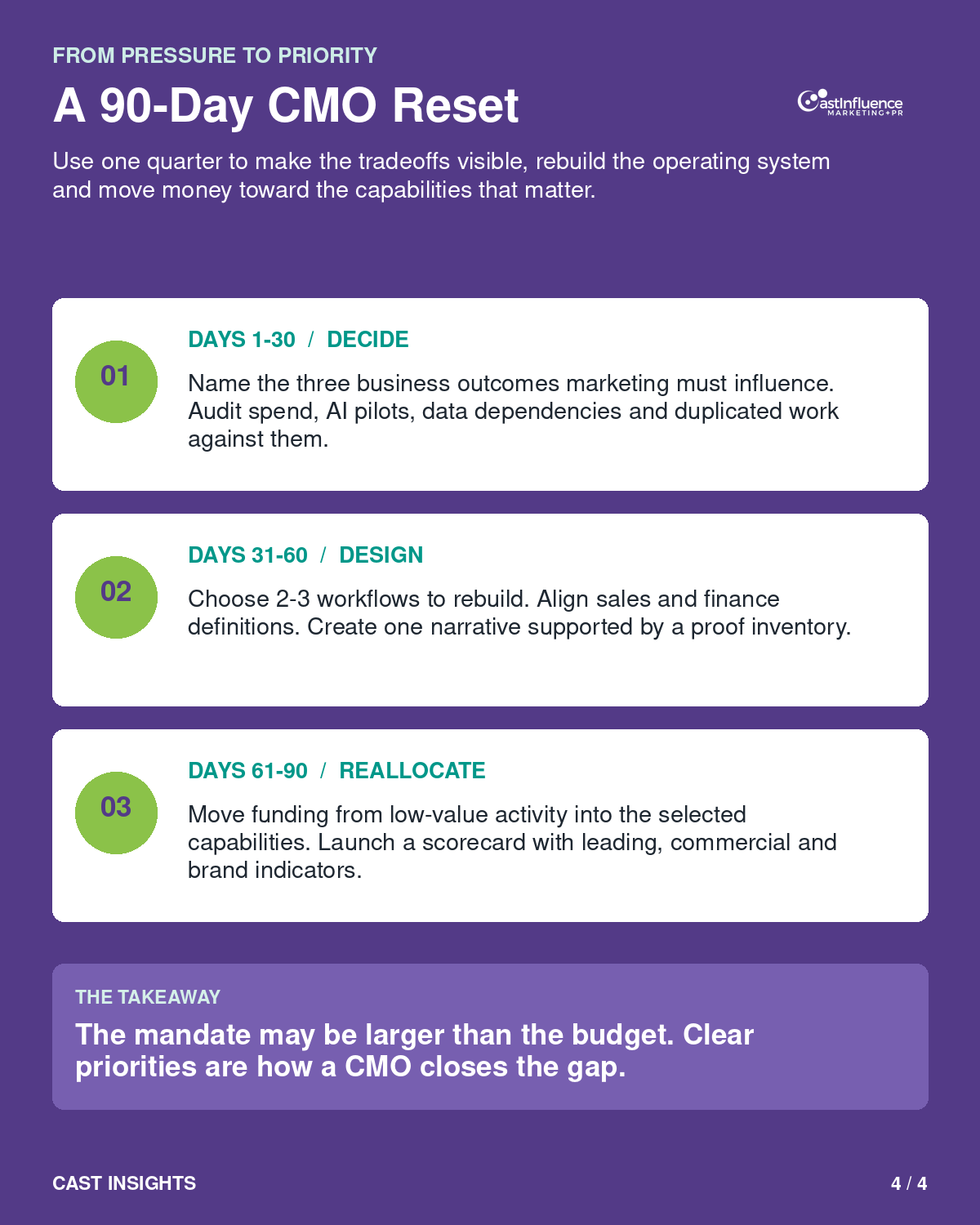
- Days 1-30: Decide. Name the three business outcomes marketing must influence. Audit spend, AI pilots, data dependencies and duplicated work against those outcomes.
- Days 31-60: Design. Choose two or three workflows to rebuild, establish shared sales and finance definitions, and create one narrative supported by a proof inventory.
- Days 61-90: Reallocate. Move funding from low-value activity into the selected capabilities. Launch a scorecard that combines leading, commercial and brand indicators.
Frequently Asked Questions
What is the biggest challenge for CMOs in 2026?
The central challenge is delivering growth and AI-enabled transformation without meaningful budget expansion. It forces CMOs to make explicit tradeoffs among short-term performance, long-term demand and future capability.
How should a CMO prioritize AI investment?
Start with business outcomes, not tools. Select a few workflows with measurable value, reliable data, clear ownership and appropriate human review. Scale only after the team can repeat the result safely.
How can CMOs prove marketing ROI in a long B2B sales cycle?
Use a layered framework. Track immediate efficiency for optimization, pipeline and opportunity movement over the medium term, and revenue, lifetime value and brand demand over longer periods. Align definitions with sales and finance.
Should brand investment be cut when budgets are tight?
Not automatically. Cutting all long-term demand creation can improve a short reporting window while weakening future growth. Protect brand programs that have a defined audience, a distinct message and evidence of commercial influence, and stop programs that lack those fundamentals.
The CMO Advantage in 2026 Is Clarity
The strongest CMO response to 2026 is not to do everything faster. It is to make the few choices that the company can understand, support and measure.
Treat the budget as a flexible portfolio. Build AI around real workflows. Measure the buyer journey on the timeline it actually follows. Turn proprietary knowledge into discoverable authority. And redesign the team around judgment as much as output.
The mandate may be larger than the budget. Clear priorities are how a CMO closes that gap.
What to do next
A 90-Day CMO Reset for 2026
- Days 1-30: Decide. Name the three business outcomes marketing must influence. Audit spend, AI pilots, data dependencies and duplicated work against those outcomes.
- Days 31-60: Design. Choose two or three workflows to rebuild, establish shared sales and finance definitions, and create one narrative supported by a proof inventory.
- Days 61-90: Reallocate. Move funding from low-value activity into the selected capabilities. Launch a scorecard that combines leading, commercial and brand indicators.
Working through this right now?
Score the moment in two minutes, or talk it through with a senior operator.