
Why Your B2B SaaS PR Strategy Isn't Working
A strong B2B SaaS PR strategy helps the market understand why your company matters
Your team has a media list and a polished press release. The pitches go out. Then comes silence.
That does not mean PR cannot work. More often, your team is treating public relations as distribution instead of business strategy.
A strong B2B SaaS PR strategy helps the market understand why your company matters and builds credible third-party proof. When those pieces are missing, more outreach creates more ignored emails.
Here is how to find the problem and reset your approach.
First, define what “working” means
PR cannot succeed against an undefined goal. “Get us into TechCrunch” is not a strategy.
The right objective depends on the company's moment. A Series A startup may need category recognition and investor confidence. A growth-stage platform may need to support enterprise sales or become part of an industry conversation.
Choose one primary business outcome and define the audience whose perception or behavior must change. This foundation of a goal-oriented public relations strategy gives every story and media target a clear job.
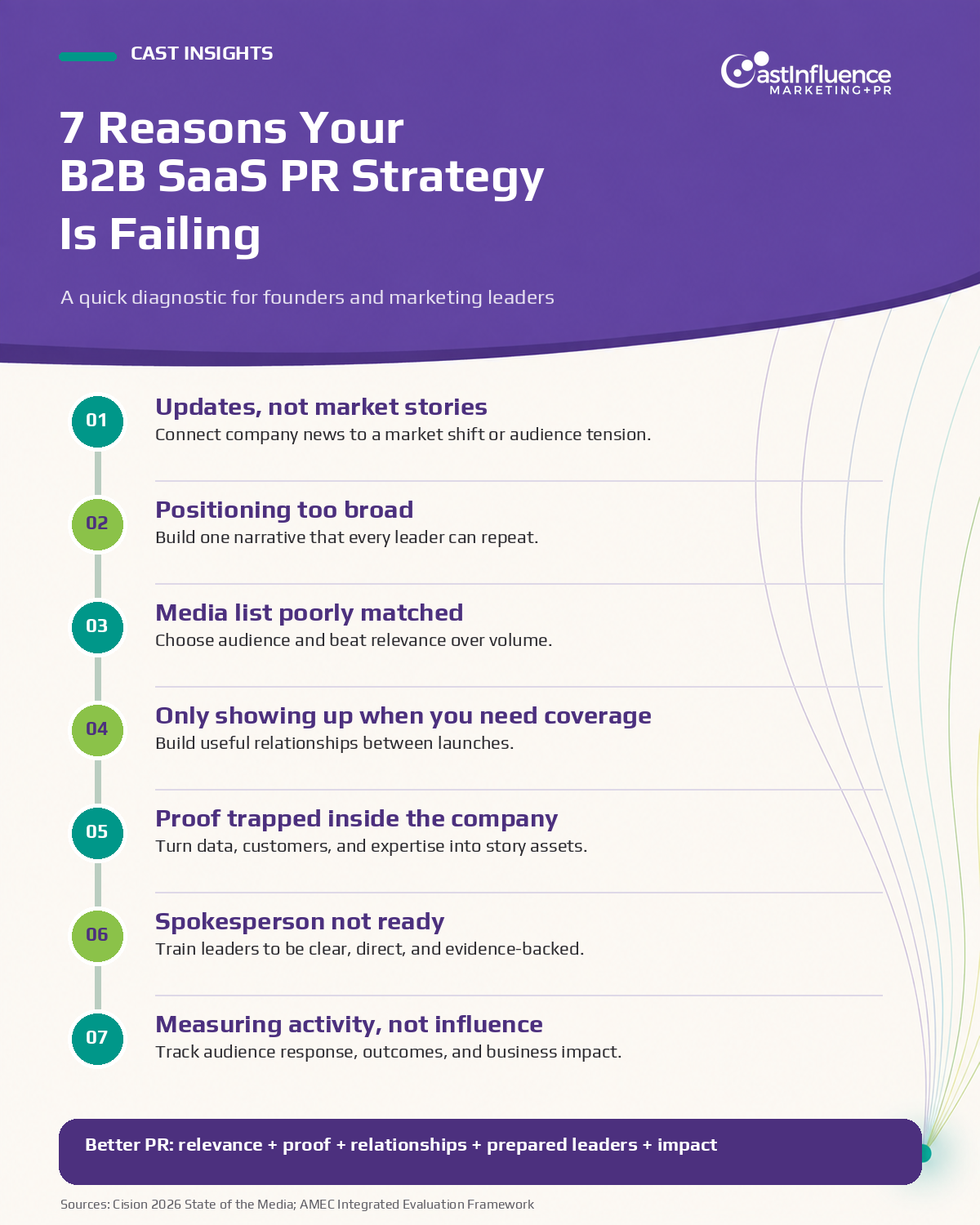
Seven reasons your B2B SaaS PR strategy is failing
1. You are pitching company updates, not market stories
Your new feature matters deeply to your product team. A journalist still has to answer a different question: Why will my audience care now?
Funding, hires, partnerships, and product releases can support a story, but the announcement alone is rarely the story. A stronger pitch connects the news to a market shift, customer behavior, useful data, or a tension affecting the publication's readers.
In its 2026 State of the Media findings, Cision reports that 66% of journalists rely on PR-provided content for story ideas. Yet 72% say fewer than one-quarter of their pitches are relevant. The opportunity exists. Relevance is the gate.
Before pitching, finish this sentence: “This matters to the outlet's audience because...” If the answer is only about your company, the angle is not ready.
2. Your positioning is too broad to repeat
Many SaaS messages collapse into the same language: an all-in-one platform that uses AI to streamline workflows, improve productivity, and drive growth.
Nothing in that sentence gives a reporter a memorable frame. It also gives buyers no clear reason to choose you.
Strong positioning makes four things plain:
- Who has the problem
- What has changed in their world
- Why current approaches fall short
- What distinct point of view your company can credibly own
If your leadership team describes the company in five different ways, pause media outreach. Build a message house with one central narrative, supporting proof, and a short set of claims that sales, marketing, product, and executives can all use.
3. Your media list is large but poorly matched
A spreadsheet with 1,000 contacts can still produce little value. Ask how many people on it actively cover your category, customer, technology, or business issue.
Cision's analysis of its 2026 research found that 86% of journalists will reject outreach that lacks relevance to their audience or beat. A smaller, researched list usually beats a mass send because it allows you to tailor the angle to each reporter's recent work and readers.
Build your list in tiers. Start with the trade publications, newsletters, podcasts, and analysts that influence buyers. Add larger business and technology outlets when the story has a broader consequence. For each priority contact, record recent coverage and the value you can offer.
4. You only show up when you want coverage
If every interaction begins with “Will you cover our announcement?”, your company becomes another request in an overloaded inbox.
Useful relationships form between launches. Share relevant data. Offer an expert without demanding a company mention. Respond quickly when a reporter needs context. Read and thoughtfully engage with their work. Become a reliable source before asking them to spend attention on your story.
In complex SaaS categories, trust compounds when your team is accurate, candid, and easy to work with.
5. Your proof is trapped inside the company
B2B SaaS teams often sit on strong story assets without recognizing them. Product usage patterns, anonymized benchmarks, customer research, implementation lessons, and executive expertise can all create news value.
Turn those assets into an editorial pipeline. One analysis of customer behavior can support a report, byline, webinar, sales deck, and targeted pitches. A founder's informed disagreement with conventional wisdom can become a defensible thought-leadership platform.
Unsupported opinions sound promotional. Original data, customer examples, and informed experts give journalists something they can verify and use. This is why SaaS PR must translate technical ideas into credible market narratives.
6. Your spokesperson is not ready
Winning the interview is only half the job. An executive who answers in product jargon, avoids direct questions, or cannot support a claim can weaken the resulting story.
Prepare spokespeople around the audience's problem, the company's point of view, and the evidence behind it. Practice concise answers and tough questions. Good media training should make an executive clearer and more useful, not robotic.
7. You are measuring activity instead of influence
Press releases distributed, pitches sent, and potential impressions describe effort or reach. They do not show whether PR changed anything that matters.
Measurement should begin with the objective, not with the reporting dashboard. The AMEC Integrated Evaluation Framework recommends connecting communications activity to outputs, audience responses, outcomes, and organizational impact.
For a B2B SaaS company, that might mean tracking:
- Outputs: Relevant coverage, message pull-through, executive interviews, and quality links
- Audience response: Referral visits, engaged time, branded search, content sharing, and sales-team usage
- Outcomes: Improved share of voice, target-account engagement, analyst recognition, or stronger buyer familiarity
- Business impact: Influenced opportunities, shorter trust-building cycles, recruiting lift, partnerships, or investor interest
A 90-day reset for SaaS public relations
Days 1–30: Sharpen the narrative
Interview customers, sales leaders, product experts, and executives. Audit competitor language and coverage. Identify the market tension your company can address with authority.
Finish the month with one core narrative, three supporting messages, a proof inventory, clear campaign objectives, and a tightly defined audience.
Days 31–60: Build the story engine
Create three to five story angles. Package supporting data, customer evidence, expert access, and visuals. Map each angle to a small group of relevant journalists, podcasts, newsletters, and analysts.
At the same time, prepare spokespeople and establish a fast approval process. Your PR plan should be able to respond to breaking conversations without abandoning accuracy.
Days 61–90: Pitch, learn, and compound
Begin with the highest-fit contacts. Track replies, objections, questions, and language that resonates. A pass still offers intelligence: the timing may be wrong, the proof thin, or the angle insufficiently distinct.
Use those signals to refine the next wave. Amplify earned coverage through executive social channels, sales enablement, customer communications, and your website. One placement should become an asset across the business, not a link that disappears into a monthly report.
Measure PR like a business system
Review performance monthly, but allow enough time to build recognition and relationships. Separate leading indicators from lagging outcomes.
Leading indicators include better journalist response, inbound requests, and stronger message pull-through. Lagging outcomes include share-of-voice gains, branded demand, sales influence, and reputation change.
Ask three questions in every review:
- Which story themes earned attention from the right audience?
- Which proof points were repeated by media, buyers, or partners?
- What will we stop, improve, or invest in next?
Frequently asked questions
How long does B2B SaaS PR take to work?
A newsworthy announcement can earn immediate coverage, but durable authority takes consistent work. Plan in quarters, not days; relationships and third-party validation compound over time.
Does a SaaS company need a press release for every announcement?
No. Use one when you need a durable, citable source of truth or have material news. Smaller updates may work better as targeted pitches, executive posts, customer stories, or direct user communications.
Should PR focus on top-tier media or trade publications?
Start with audience fit. A respected trade publication, analyst, podcast, or newsletter may influence buyers more directly than a large general-interest outlet. Pursue top-tier coverage when the story has a broad, timely consequence.
Can PR support SaaS pipeline growth?
Yes, usually as an influence channel rather than a direct-response channel. Coverage can build awareness and credibility, support sales conversations, and strengthen branded search. Track those assists without pretending PR acted alone.
Make the story bigger than the announcement
When a B2B SaaS PR strategy stalls, the answer is rarely “send more pitches.” The answer is to make the company more relevant, more credible, and easier to understand.
Start with a business objective. Build a distinct market narrative and support it with proof. Invest in the right relationships. Then measure whether the work changes attention, understanding, and action among the people who matter.
That is how PR moves from a launch tactic to a durable source of market authority.
What to do next
Working through this right now?
Score the moment in two minutes, or talk it through with a senior operator.